The Master's Medal
Awarded to any person in aviation, at any time, for an act or other achievement in aviation considered worthy of the Medal, as soon as the facts of the event are clear. This is intended to be an immediate award, made at the discretion of the Master. It is done so on the advice of the Trophies and Awards Committee, after careful consideration and due diligence.
(Amended Terms of Reference 2019)
2025 awarded to: RAF Flight 1312 and Crew of Rescue 1
On 22 July 2024, two aircraft of 1312 Flight RAF, and a civil SAR helicopter based at Stanley in the Falklands, ‘Rescue 1’, demonstrated extraordinary leadership and teamwork during a complex search and rescue operation in the South Atlantic. This combined operation resulted in the successful rescue of 14 sailors from the fishing vessel ‘Argos Georgia’ which had suffered storm damage and was taking on water 190nm East of the Falkland Islands in extreme weather conditions.
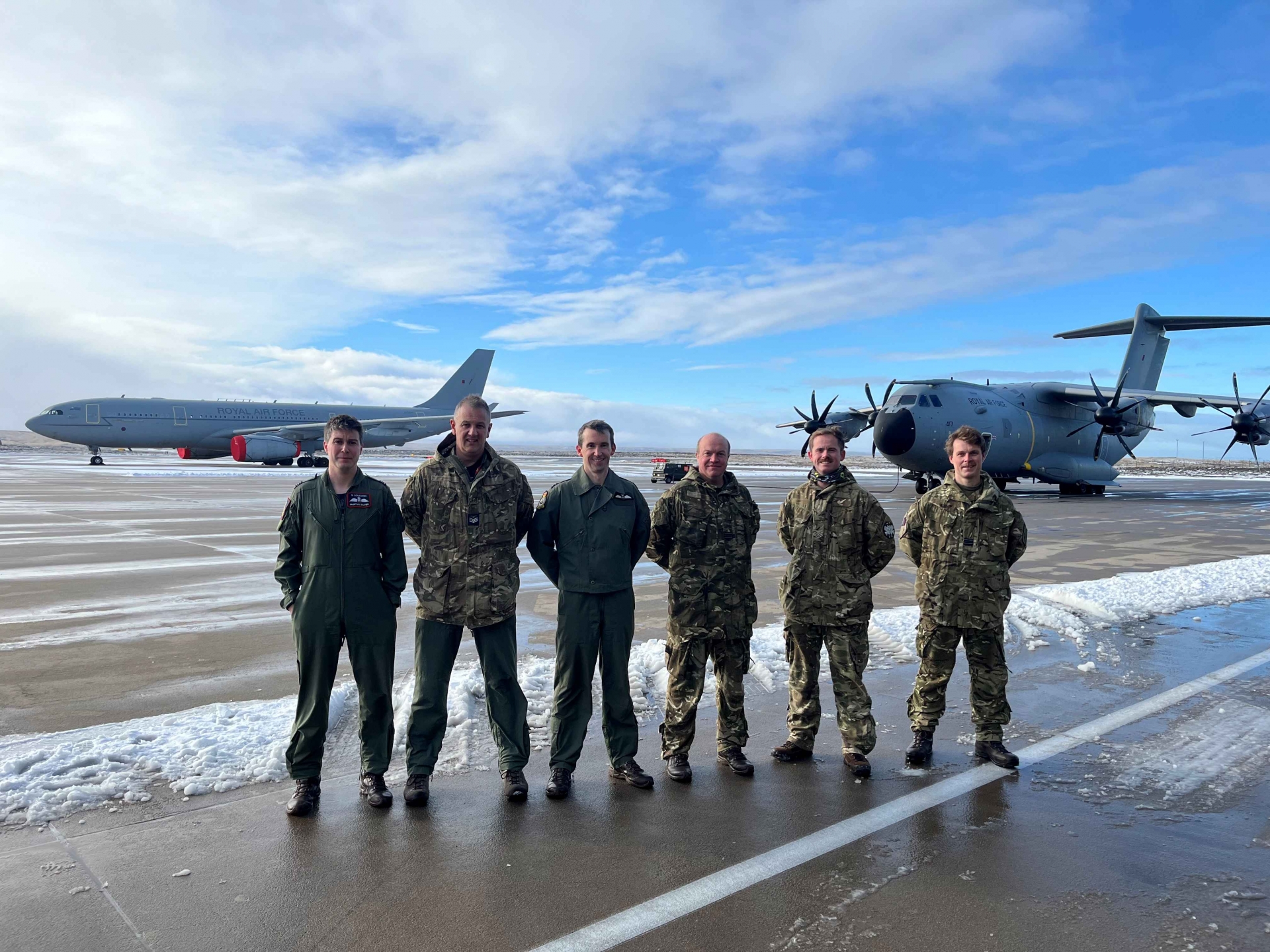 When ‘Argos Georgia’ issued a distress call, authorities initiated a search and rescue operation involving an RAF A400M Atlas and ‘Rescue 1’. The A400M captain and initial on-scene commander, located the survivors and directed the helicopter to maximise its limited time on scene. The vessel was sinking and listing at 45 degrees, with two fully-inflated and one partially-inflated life rafts, and one life jacket (thought to be a person in the water) visible in the water. As ‘Rescue 1’ arrived on scene, with only a potential 20 minutes on task, the crew were informed by the A400M that the life jacket was empty and so the focus moved to the casualties still on the vessel. ‘Rescue 1’ positioned in a hover alongside the vessel which had only part of the stern out of the water. The crew could see four people still onboard and clinging to the highest point of the stern. ‘Rescue 1’ manoeuvred to overhead the stricken vessel but with the deck height fluctuating 30-50 feet within seconds whilst also pitching, the crew decided it was unsafe for both casualties and the winch-paramedic to attempt to board.
The decision was made to reposition to the nearest life raft which was only partially inflated and had three survivors visible. The plan was to establish contact with the life raft, deploy a hi-line, and then the winch-paramedic would detach from the winch cable, place two casualties in rescue strops whilst he controlled any swing from below with the hi-line. This would leave him vulnerable as he would be detached from the aircraft and, ultimately, if there were any malfunctions causing the aircraft to depart the scene, he would be left behind at that point.
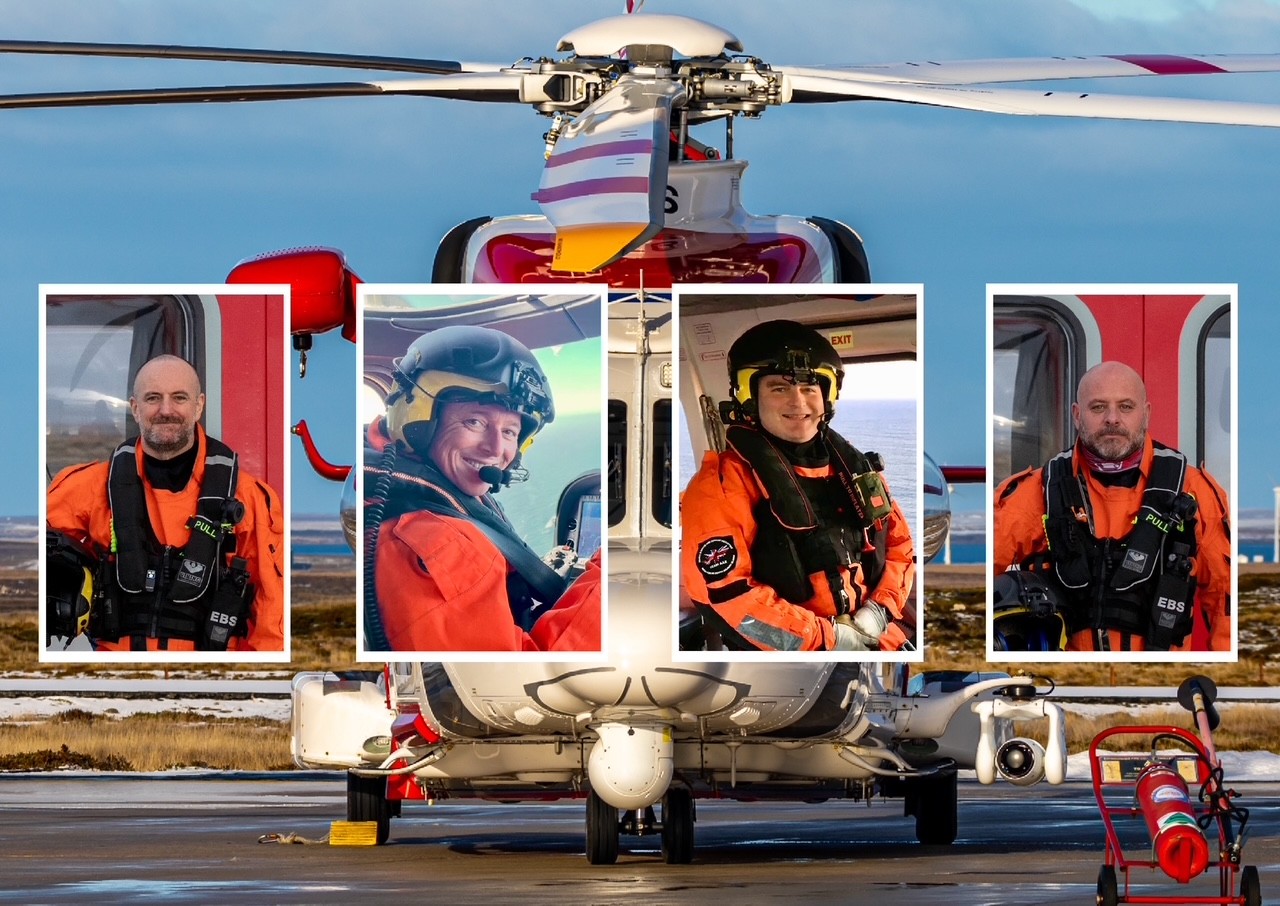
With only 10 minutes remaining on scene, on the third attempt to winch to the raft, the winch-paramedic was engulfed by a wave from behind and the life raft was swept away. Having sustained an injury to his neck and shoulder he was recovered to the aircraft, but with only five minutes remaining on scene, an injured winch-paramedic and 190nm return journey, it was apparent that a further attempt on the life-raft was not feasible. The winch-operator then spotted a person floating in the water just ahead of ‘Rescue 1’ and it was agreed to attempt to recover the casualty. However, on reaching the person, they were unresponsive as a strop was placed around them and during winching to the aircraft they slipped from the strop and fell back into the sea. ‘Rescue 1’ was now two minutes past fuel endurance and so had to return to Stanley. This left the A400M as the only asset available to maintain oversight and the captain initiated a surface vessel rescue while maintaining visual contact with the life rafts.
On landing back at Stanley, it was apparent that due to on-scene conditions and eastward drift of the life-rafts, a further rescue attempt by ‘Rescue 1’ that night would be fruitless. Unfortunately, the weather worsened considerably overnight and with 75kt winds, cloud and freezing rain at the surface, it was impossible to launch a subsequent sortie the next day.
As night fell, and nearing the limit of aircraft endurance, the A400M crew co-ordinated a handover with an RAF Voyager aircraft, ensuring all occupied life rafts were located despite stronger-than-anticipated winds and poor visibility. The Voyager had been scrambled from the Falklands to take-over overwatch duties — a role the Voyager was neither designed nor equipped for. On arrival, the Voyager crew navigated severe turbulence and thunderstorms at low level; a remarkable feat given the Voyager’s size and weight. Without night vision and with salt spray obstructing visibility, the Voyager adapted air-to-air refuelling navigation procedures to create an improvised search pattern, ensuring oversight of the life rafts. Through careful crew rotation and effective communication, the Voyager maintained operational focus throughout the nine-hour mission and when the first surface vessel struggled to locate the life rafts due to the sea swell, established communications and guided the vessel to the survivors.
In the face of extreme adversity, the co-ordination between the A400M and Voyager aircraft, with quick decision-making, adaptability to a scenario for which neither aircraft nor crew were trained, and the courage and determination showed by the crew of ‘Rescue 1’, the crews of all three aircraft demonstrated outstanding leadership, resilience, and professionalism, leading to the eventual rescue of 14 sailors. For their combined actions and achievement in a successful rescue mission, the crews of all three aircraft are jointly awarded the Master’s Medal.
Previous Winners:
... of the Guild Medal
1976 F A Laker Esq
1977 awarded twice
Captain J Schuman (posthumously) and Herr J Veito of Lufthansa Flight 181
The Royal Air Force Red Arrow Aerobatic Team
... of the Master's Medal
1985 Captain John Testrake
1986 PO ACMN L Slater
1987 R Branson Esq and Per Lindstrand
1988 Captain S Yousif
1989 not awarded
1990 FO A Atchison
1991 Miss H Sharman
1992 not awarded
1993 Captain E J Wyer
1994 not awarded
1995 Air Cdre A N Nicholson OBE QHS RAF
1996 - 1998 not awarded
1999 Brian Jones and Bertrand Piccard of the Breitling Orbiter 3
2000 not awarded
2001 Polly Vacher
2002 Caroline Gough-Cooper and Imogen Asker
2003 David K Hempleman-Adams OBE
2004 HMS ENDURANCE
2005 Not Awarded
2006 The crew of 7 Flt AAC - WOI1 Challis (Aircraft Commander), Sgt Khanlarian and Cpl Leah
2007 Awarded twice:
Apache Patrol Members of 656 Sqn AAC
POACM James O'Donnell QGM
2008 not awarded
2009 Awarded twice:
The Crew of US Airways Flight 1549
Captain Charles "Chalkie" Stobbart
2010 Awarded twice:
Captain Michael Fairhurst and First Officer James Brown
Captain Stephen Noujaim
2011 Lt Cdr William Strickland USCG
2012 David "Wheely Dave" Sykes
2013 Awarded twice:
Lt Cdr Vincent Jansen USCG
Sgt Rachael Robinson QGM
2014 not awarded
2015 Solar Impulse - Dr Bertrand Piccard and Andre Borschberg
2016 Awarded twice:
Tracey Curtis-Taylor
Timothy Peake CMG BSc(Hons)
2017 Awarded twice:
Flt Sgt Mike Rowlands
Cdr Matthew Grindon RN
2018 not awarded
2019 Awarded to:
Winchman Paramedic Carlton Real
Wg Cdr Rob Caine MBE MA RAF
James Ketchall
2020 Flt Lt Richard Davoren RAF
2021 Awarded twice:
Lt Col Adam Thornton USAF
Flt Lt Matthew Douglas RAF
2022 Awarded twice:
Zara Rutherford
Mack Rutherford
2023 Flight Lieutenant Matthew Pilbeam RAF
2024 Captain Neil Jeffers